Integrating legacy systems with cloud technology is often necessary where critical applications cannot be immediately replaced. In many cases, organisations need to maintain existing systems while introducing cloud infrastructure to support new workloads and services.
Rather than eliminating legacy systems outright, integration allows them to continue operating while a longer-term modernisation strategy is implemented.
Planning a gradual transition
It may not always be possible to fully eliminate legacy systems straight away. In some cases, it is more effective to plan a gradual migration away from these systems towards a fully modernised infrastructure.
This approach reduces risk and allows workloads to be transitioned over time, rather than introducing disruption through immediate replacement.
There are several ways to manage this.
Hybrid cloud
The hybrid cloud model, which unifies multiple hosting environments including on-premise, private cloud and public cloud, allows workloads to be assigned to the environment best suited to handling them.
Hybrid cloud enables legacy components to remain on-premise, while cloud infrastructure is used to support new systems and applications.
The structure of a hybrid environment is flexible. As migration progresses, capacity can gradually shift towards cloud platforms while reducing reliance on legacy infrastructure.
This makes hybrid cloud a practical foundation for phased modernisation.
System integration
One of the main challenges with legacy systems is their limited ability to integrate with newer technologies, which can result in fragmented workflows and inefficiencies.
While legacy systems may eventually be retired, integration can improve how they operate in the short to medium term.
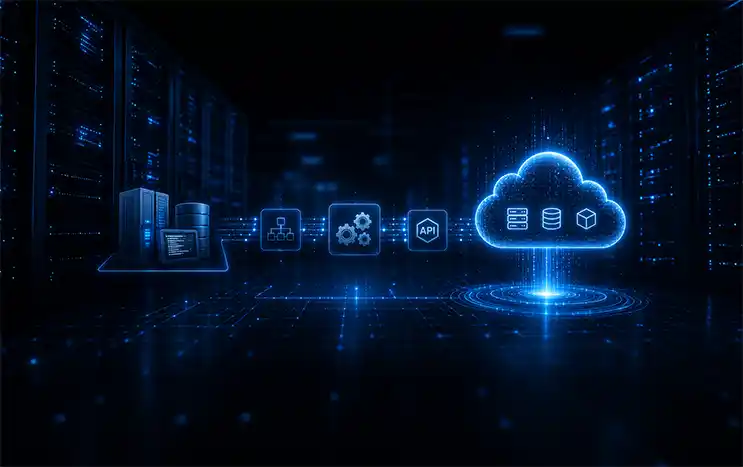
APIs can be used to connect legacy systems with cloud-based applications, enabling:
- Data exchange between environments
- Functional interfaces for modern services
- Improved interoperability without replacing core systems
This allows organisations to extend the value of legacy platforms while introducing more flexible, cloud-based capabilities.
Bespoke solutions
Integrating legacy systems into a modern infrastructure often requires a bespoke approach. Each system has unique dependencies, performance requirements and constraints that need to be considered.
A tailored solution typically involves:
- Assessing existing infrastructure and application dependencies
- Designing an integration architecture aligned with operational requirements
- Defining a migration pathway that balances performance, cost and risk
This ensures the integration strategy reflects how systems behave in production, rather than applying a standardised approach.
Performance and operational considerations
Integration introduces additional complexity across environments. Legacy systems are often not designed for distributed architectures, which can impact performance when interacting with cloud services.
Considerations include:
- Latency between on-premise and cloud environments
- Data consistency across systems
- Communication overhead between integrated components
These factors should be addressed during the design phase to ensure reliable operation.
Moving towards modernisation
Integration is typically not the end state. Over time, organisations may choose to refactor or replace legacy components as cloud adoption increases.
A phased approach allows:
- Gradual reduction of technical debt
- Incremental improvement of system performance
- Alignment with evolving business requirements
As more workloads transition to the cloud, dependency on legacy systems decreases, improving overall flexibility.
The role of managed infrastructure
Integrating legacy and cloud environments requires ongoing management to maintain performance, security and reliability.
A managed infrastructure provider supports this by:
- Monitoring performance across environments
- Managing resource allocation and optimisation
- Ensuring consistent security and governance
This provides the operational stability required to run integrated systems effectively.
The next steps
Integrating legacy systems with cloud technology is often a necessary stage in cloud adoption.
If you are assessing how to connect existing systems with modern infrastructure, defining a clear integration strategy can help ensure performance, scalability and long-term flexibility. Contact us to speak to a member of our team.
Related content: Reimagining legacy systems: How cloud technology can revolutionise public sector IT