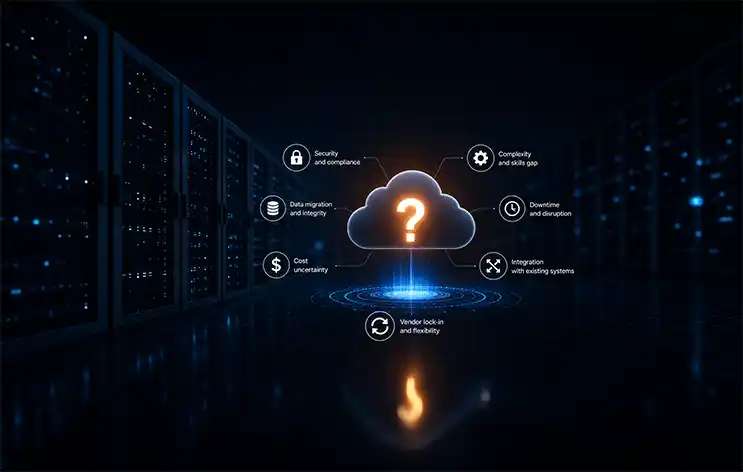
Cloud migration introduces a shift in how infrastructure is designed, managed and maintained. While the benefits are clear, organizations often approach migration with a set of concerns that reflect both technical risk and operational uncertainty.
These concerns are valid. They highlight areas where planning, architecture and governance directly affect outcomes.
Cost control and financial predictability
One of the most common concerns is cost. Cloud infrastructure replaces fixed capital expenditure with a variable consumption model, which can make forecasting more complex.
Without clear visibility into resource usage, costs can increase over time. This is particularly relevant where workloads are not optimized, or where scaling behavior is not fully understood.
Cost predictability improves when usage is monitored closely, and when infrastructure is designed with efficiency in mind. This includes right-sizing resources, removing unused capacity and aligning workloads with actual demand.
Security and data protection
Security concerns often center on how data is protected once it moves to the cloud. This includes access control, encryption and the handling of sensitive information across environments.
Cloud infrastructure requires a structured approach to identity and access management, alongside clear policies for data handling. These controls must reflect how the environment is configured, rather than relying on assumptions carried over from on-premise systems.
Security is also an ongoing responsibility. Monitoring, patching and configuration management all contribute to maintaining a secure environment over time.
Downtime and migration risk
The migration process itself introduces risk, particularly for critical systems. Concerns around downtime, data integrity and service disruption are common, especially where systems have complex dependencies.
Even well-planned migrations can encounter challenges if applications rely on specific configurations or integrations. Testing, validation and phased migration approaches help reduce this risk, allowing workloads to be moved in a controlled manner.
Operational continuity depends on how thoroughly these dependencies are understood before migration begins.
Loss of control and visibility
Moving to the cloud can create a perception of reduced control, particularly for organizations used to managing physical infrastructure.
In practice, control shifts rather than disappears. Infrastructure becomes software-defined, and visibility depends on how monitoring and management tools are implemented.
Concerns in this area often relate to whether teams can maintain the same level of oversight across performance, security and availability. This requires clear operational processes and appropriate tooling to ensure transparency across the environment.
Application performance and reliability
Performance is another key concern, particularly where applications have strict latency or availability requirements.
Cloud environments behave differently to on-premise infrastructure. Network latency, resource contention and scaling mechanisms all influence how applications perform under load.
Workloads that are not designed or adapted for the cloud may experience inconsistent performance. This is often addressed through architectural changes, load balancing and resource optimization aligned with demand patterns.
Skills and internal capability
Cloud migration introduces new operational requirements, including automation, orchestration and continuous monitoring.
Teams may not have prior experience managing infrastructure in this way, which creates a skills gap. This can affect how effectively the environment is maintained, optimized and secured.
Addressing this concern typically involves a combination of training, tooling and external support, depending on the scale and complexity of the infrastructure.
What you should consider
Cloud migration concerns should be treated as part of the planning process rather than barriers to adoption.
This includes evaluating:
- How costs will be monitored and controlled
- What security controls are required for your data and workloads
- How migration risk will be managed and reduced
- What level of visibility and control is needed post-migration
- Whether your team has the capability to operate cloud infrastructure effectively
A structured approach to these considerations allows concerns to be addressed systematically, rather than reactively.
The role of managed infrastructure
Many cloud migration concerns relate to ongoing management rather than the migration itself. Performance, security and cost control all depend on how the environment is operated after workloads are moved.
A managed infrastructure partner provides oversight across these areas, supporting monitoring, optimization and governance. This ensures that concerns around control and stability are addressed through consistent operational management.
The next steps
Understanding your cloud migration concerns is a critical step in building a resilient and well-governed infrastructure strategy.
If you are planning a migration or reviewing your current environment, a structured discussion can help clarify risks, priorities and the most appropriate approach. Contact us to speak to a member of our team.