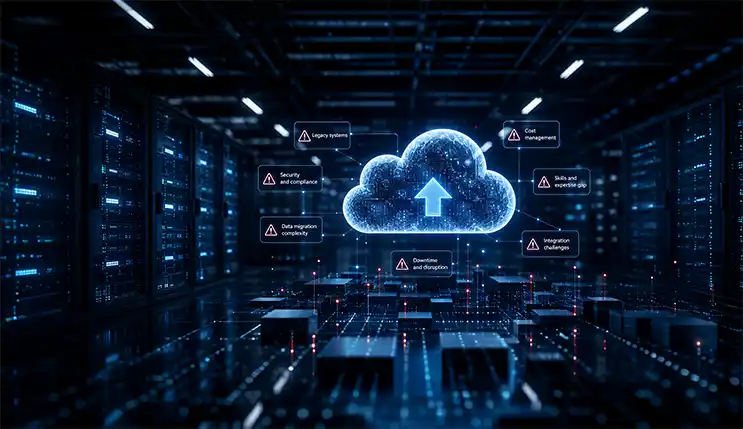
Cloud migration is the process of moving applications, workloads and data from on-premise infrastructure or existing environments into the cloud. While the benefits are well established, the migration itself introduces a set of challenges which need to be addressed at both an architectural and operational level.
These challenges are not isolated to the point of migration. They influence how infrastructure performs, scales and is governed over time.
Architectural complexity and workload suitability
Not all workloads are immediately suited to cloud environments. Applications built for on-premise infrastructure often rely on fixed resources, tightly coupled components or legacy dependencies which do not translate cleanly to cloud architectures.
When these workloads are migrated without modification, they may function, but they do not fully align with how cloud infrastructure behaves. This creates constraints around scalability, resilience and performance.
In practice, this means organizations must assess whether to rehost, replatform or refactor workloads. Each approach introduces different levels of complexity, cost and risk, and the correct decision depends on how critical the workload is and how it is used in production.
Technical debt and legacy constraints
Cloud migration often exposes existing technical limitations. Legacy systems, outdated dependencies and inefficient configurations are carried into the new environment unless they are addressed during migration.
This creates technical debt that continues to impact performance and maintainability. Over time, this can increase operational overhead, as teams need to manage workarounds rather than optimized solutions.
Technical debt can be a deliberate decision when speed is a priority, but it requires a clear plan for remediation. Without this, the cloud environment inherits the same constraints as the previous infrastructure, with additional complexity layered on top.
Cost management and resource inefficiency
Cloud environments offer flexible resource allocation, but this flexibility introduces variability in cost. Without careful planning, workloads can consume more resources than required, particularly if they are not optimized for the cloud.
Lift and shift migrations are a common example, where workloads retain their original resource profiles despite operating in a different environment. This can lead to over-provisioning, inefficient scaling and higher ongoing costs.
Cost management in the cloud depends on visibility, monitoring and continuous optimization. It also requires an understanding of how workloads behave under different levels of demand, rather than relying on static provisioning models.
Security and governance considerations
Security in the cloud operates on a shared responsibility model, where infrastructure, access controls and configurations must be actively managed.
During migration, gaps can emerge if security controls are not aligned with the new environment. Identity management, data protection and network configurations all require review to ensure they reflect how the infrastructure is structured.
Governance also becomes more complex, particularly for organizations operating across multiple regions or environments. Compliance requirements, data sovereignty and access policies must be defined and enforced consistently.
These considerations extend beyond the migration itself and require ongoing oversight to remain effective.
Operational disruption and migration risk
Migrating workloads introduces a degree of operational risk, particularly for business-critical systems. Downtime, data loss and performance degradation are all potential concerns during the transition.
Even with detailed planning, dependencies between systems can create unexpected challenges. Applications which rely on specific latency, integrations or configurations may not behave as expected once migrated.
To reduce risk, migrations are often phased, with workloads prioritized based on their complexity and importance. This approach allows issues to be identified and resolved without affecting the entire infrastructure.
Skills, tooling and internal capability
Cloud environments require a different operational approach compared to traditional infrastructure. Teams need to manage automation, orchestration, monitoring and security within a more dynamic environment.
This creates a skills gap for organizations which are transitioning from on-premise models. Without the right expertise, it becomes difficult to optimize workloads, manage costs or maintain performance.
Tooling also plays a role, as visibility across cloud environments depends on effective monitoring and management platforms. These tools need to be configured correctly to provide meaningful insights into performance and usage.
What you should consider
Before migrating to the cloud, it is important to evaluate how your current infrastructure will behave in a new environment.
This includes:
- The suitability of your workloads for cloud architecture
- The level of technical debt within your existing systems
- How costs will be monitored and controlled over time
- The security and governance requirements specific to your organization
- The internal capability required to manage cloud infrastructure effectively
A migration strategy should reflect these factors, rather than treating migration as a standalone project.
The role of managed infrastructure
Cloud migration is not only a technical exercise. It is an ongoing operational shift which affects how infrastructure is designed, managed and optimized.
Working with a managed infrastructure provider introduces oversight across performance, security and cost management. This ensures that workloads are not only migrated successfully, but continue to operate efficiently as requirements evolve.
The next steps
Understanding the challenges of cloud migration is a critical step in building a reliable and scalable infrastructure strategy.
If you are assessing your migration approach or reviewing existing cloud environments, speaking to an experienced team can help clarify the most appropriate path forward. Contact us to set up an initial consultation.