As container adoption has matured, the ecosystem around containerization software has expanded significantly.
With containerization now a central part of modern infrastructure strategy, many organizations are looking for ways to improve application portability, simplify deployment processes and support more consistent operations across hybrid environments.
The containerization platform selected influences how applications are deployed, secured, monitored and maintained over time, shaping operational processes across the wider infrastructure environment.
For many organizations, containerization also forms part of a broader infrastructure modernization strategy alongside virtualization, automation and hybrid cloud adoption.
It is therefore crucial to understand the different containerization software available, and assess the best option for your needs.
What containerization software does
Containerization software packages an application and its dependencies into a consistent runtime environment known as a container.
Unlike traditional virtual machines, containers share the host operating system kernel while isolating application processes from one another. This allows containers to run with lower overhead and faster startup times compared with full virtual machine environments.
However, running containers at scale introduces additional operational requirements. Organizations need mechanisms for:
- Scheduling workloads across infrastructure
- Managing networking between services
- Controlling resource allocation
- Handling updates and scaling
- Applying security policies
- Monitoring application health
This is where orchestration and platform management become increasingly important.
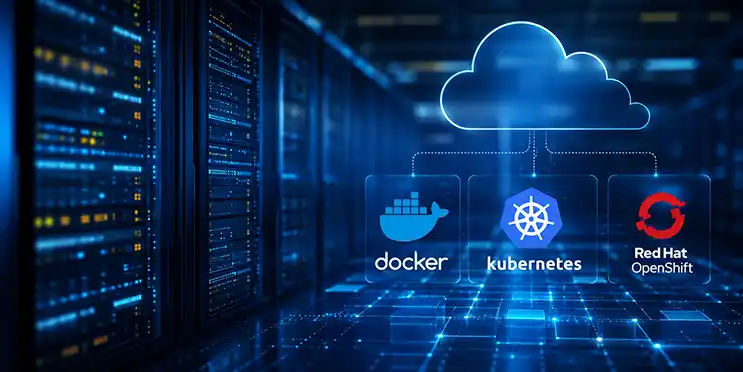
Docker
Docker played a major role in accelerating mainstream container adoption, simplifying the process of building, packaging and running containers. For many organizations, Docker remains the entry point into containerization.
Docker is particularly effective for:
- Local development environments
- Smaller application deployments
- CI/CD pipelines
- Simplified application packaging
- Consistent developer workflows
The operational model is relatively straightforward for smaller environments. Containers can be deployed quickly, updated consistently and moved between systems with minimal modification.
However, Docker by itself is not designed to manage large-scale production container estates.
As the number of containers and services increases, operational complexity grows around scheduling, resilience, networking and lifecycle management. Managing these areas manually can become difficult, particularly across distributed infrastructure environments.
For this reason, many organizations move beyond standalone container runtimes towards orchestration platforms as container adoption matures.
Upstream Kubernetes
Kubernetes has become the dominant orchestration platform for containerized applications.
Originally developed by Google and now maintained by the Cloud Native Computing Foundation, Kubernetes automates many of the operational processes involved in running containers at scale.
This includes:
- Container scheduling
- Service discovery
- Load balancing
- Automated scaling
- Health monitoring
- Rolling updates
- Self-healing behaviors
Kubernetes allows infrastructure teams to manage large numbers of containerized workloads consistently across clusters.
This flexibility has made Kubernetes highly attractive for organizations building modern application environments, particularly where applications are distributed across multiple services or infrastructure environments.
However, upstream Kubernetes also introduces significant operational responsibility.
Running Kubernetes reliably requires ongoing management of:
- Cluster upgrades
- Security patching
- Networking configuration
- Storage integration
- Access control
- Observability tooling
- Resource governance
The platform provides the orchestration framework, but long-term stability depends heavily on how clusters are configured, maintained and standardized.
For organizations without dedicated platform engineering teams, this operational overhead can become difficult to manage consistently over time.
Red Hat OpenShift
Red Hat OpenShift builds on Kubernetes by adding enterprise lifecycle management, integrated tooling and operational standardization.
While upstream Kubernetes provides the orchestration layer, OpenShift introduces a more structured operational platform designed for production environments.
This includes integrated capabilities such as:
- Automated lifecycle and upgrade management
- Built-in security controls
- Integrated observability and monitoring
- Centralized policy management
- Role-based access controls
- CI/CD tooling integration
- Multi-cluster management
This operational consistency becomes increasingly important as container environments scale.
Many organizations adopting Kubernetes encounter challenges maintaining version consistency, applying security policies uniformly and coordinating upgrades across environments. OpenShift addresses many of these areas through standardized operational tooling.
OpenShift also supports hybrid infrastructure strategies.
Clusters can operate across private cloud, dedicated infrastructure, colocation environments and public cloud platforms while maintaining a consistent orchestration layer.
This infrastructure flexibility can help reduce operational fragmentation across environments.
Another important consideration is the relationship between containers and existing virtualized workloads. Traditional virtual machines, legacy applications and containerized services often need to coexist within the same operational estate.
Through OpenShift Virtualization, OpenShift supports management of both containers and virtual machines within a unified platform framework. This can simplify operational management during longer-term infrastructure modernization programs.
For organizations evaluating containerization software as part of a broader infrastructure strategy, this operational integration is often more significant than individual platform features.
What you should consider when choosing containerization software
There is no universal container platform suitable for every organization. The right solution depends on application architecture, operational maturity and long-term infrastructure goals.
Several areas are particularly important to evaluate.
Internal operational capability
Some platforms provide flexibility but require substantial internal expertise to manage effectively.
Organizations should assess whether they have the in-house capability to manage cluster operations, upgrades, observability and security consistently over time.
Existing workload architecture
Not all applications are immediately suited to containerization.
Legacy systems, stateful applications and tightly coupled architectures may require additional planning or phased migration strategies.
Container adoption often works best when aligned with broader application modernization planning.
Governance and security requirements
Container environments introduce additional layers of operational governance.
This includes image management, access control, workload isolation, policy enforcement and patch lifecycle management.
The effectiveness of these controls depends heavily on how the platform is operated and standardized.
Long-term infrastructure strategy
Containerization should be evaluated within the context of wider infrastructure planning.
This includes hybrid cloud adoption, automation strategy, platform engineering maturity and future application deployment models.
The goal is not simply deploying containers, but creating a platform environment that remains operationally manageable as infrastructure evolves.
Containerization software and managed infrastructure
As container environments become more operationally complex, many organizations are choosing to work with managed infrastructure partners to support deployment and lifecycle management.
This is particularly relevant for Kubernetes and OpenShift environments where ongoing operational consistency directly affects stability, security and performance.
At Hyve, we support organizations deploying and managing OpenShift and containerized infrastructure across private cloud, dedicated hosting and hybrid environments.
Our approach focuses on operational oversight, infrastructure performance and long-term platform stability, with direct-to-engineer support and managed lifecycle management integrated into the wider infrastructure strategy.
If you are unsure which containerization approach is right for you, contact our experts for an initial consultation. We will discuss your current infrastructure, future goals, and any hurdles you are experiencing, and advise on the best solution to meet your needs.