What does migrating to private cloud involve?
Migrating to private cloud is an important transition that needs careful planning. The starting point can vary, whether that is your own on-premise infrastructure, another hosting provider, public cloud or a different virtualization platform such as VMware, but the process follows the same broad stages: assess your current environment, design the private cloud around your requirements, choose how data and applications will be moved, migrate in phases, and manage and optimize the platform once it is live.
Moving from on-premise infrastructure and moving from public cloud each bring their own considerations, which are covered in their own sections below.
How do you plan a migration to private cloud?
Before you begin, set out a clear strategy that takes account of your goals, the risks and how to reduce them, and your technical requirements. Key considerations include timelines, costs, data security, compliance requirements and potential downtime or integration challenges.
Start by assessing your existing environment and the dependencies between your applications, since each system has its own performance requirements and constraints. Key questions include:
- Which applications need to be moved?
- Are they ready to migrate directly to the private cloud, or will they need adjusting?
- Where should they be hosted?
- What infrastructure is needed?
Some applications can be moved as they are, an approach often called lift and shift, while others need changes first. The answers shape the design of the private cloud and the pathway for moving to it, which should balance performance, cost and risk.
How is the private cloud designed around your workloads?
A private cloud is designed around your workloads, with no fixed template to fit them into. Once you know what needs to move, architects choose the hardware, platform, network, resilience and security to match, so the environment is ready to receive your applications before the migration begins.
How is data moved: online or offline?
There are two main methods for moving data and applications to a private cloud.
Online migration
In an online migration, data and applications are transferred through a secure network connection. This suits small to medium workloads, and offers a fast, cost-effective route with minimal disruption, particularly when carried out in partnership with a hosting provider.
Offline migration
Offline migration involves physically transferring data and applications on encrypted portable storage devices. It is necessary for large volumes of data, when the network connection is unstable or unsecure, or when security or policy requirements prevent online transfers. It can take longer, but it gives a greater level of control and removes the risk of transmission errors or timeouts.
How do you migrate from on-premise infrastructure to private cloud?
Moving from on-premise infrastructure often means deciding what to do with legacy systems. It is not always possible to replace them straight away, particularly where critical applications depend on them. In many cases it is more effective to integrate them with the new environment and plan a gradual move away from them, which reduces risk and avoids the disruption of immediate replacement. If you are still weighing up the decision, our insight on why you should move from on-premise to private cloud covers the benefits.
Hybrid as a stepping stone
A hybrid arrangement lets legacy components stay on-premise while the private cloud supports new systems and applications, with each workload placed where it suits best. As migration progresses, capacity can shift gradually toward the private cloud and reliance on legacy infrastructure reduces.
Integration through APIs
Legacy systems can struggle to work with newer technologies, which leads to fragmented workflows. Application programming interfaces (APIs) can connect them to cloud-based applications, enabling data exchange between environments and better interoperability without replacing core systems.
Performance considerations
Legacy systems are often not designed for distributed architectures, so integration adds complexity. Latency between on-premise and cloud environments, data consistency across systems and communication overhead between components should all be addressed during the design phase. Over time, legacy components can be refactored or replaced as cloud adoption grows, reducing technical debt and improving performance in steps.
How do you migrate from public cloud to private cloud?
Public cloud is the right home for many workloads, and organizations choose to move selected ones to private cloud for a few common reasons. This is often called cloud repatriation, though it is rarely an exit from public cloud altogether. Surveys suggest that many organizations are moving some workloads back, but IDC finds only 8 to 9% plan to repatriate fully.
The most common reasons include:
- Cost predictability: steady workloads can be easier to budget for on a fixed monthly cost than on consumption-based billing
- Consistent performance: dedicated hardware means workloads do not compete with other customers for resources
- Security, compliance and data location: single-tenant infrastructure, a chosen hosting location and greater control over security architecture
- Control: the ability to configure the platform around your applications
- AI workloads: demanding, continuous workloads, where control over data and cost are factors
Which workloads should move?
Because the decision is made workload by workload, it helps to sort what you run before choosing what to move. Good candidates for private cloud tend to be steady, predictable workloads, those that handle sensitive or regulated data, performance-critical applications and data-heavy workloads. Workloads with highly variable or short-lived demand, or that depend on specific platform services, are often better left in public cloud.
When planning, check whether workloads rely on platform-specific services, such as managed databases, serverless functions or messaging services, that will need replacing with portable alternatives, and how identity, networking and access controls will be recreated.
What will moving data out of public cloud cost?
Charges for transferring data out, known as egress fees, have historically added to the cost of moving, although this is changing. Under the EU Data Act, cloud providers can no longer charge for switching from 12 January 2027, and in the UK, AWS and Microsoft have committed to removing egress fees for customers who switch. Check what applies to your contract, including notice periods and any committed spend or reserved capacity. Old and new environments often run side by side while you test and validate, so plan for paying for both for a period, and keep an independent copy of your data until the move has been validated.
Many organizations end up with a mix, placing each workload where it runs best. We design and manage private cloud, hybrid environments and public cloud on AWS, Microsoft Azure and Google Cloud, so workloads that stay in public cloud can be looked after alongside those that move.
How do you keep disruption to a minimum?
A staged migration keeps live services running while the move takes place. Moving less critical environments first lets you validate the process before production follows, and cutover windows can be agreed in advance so that any interruption is planned for.
While a migration is in progress, parts of an application may run in both the old and new environments, so latency between them, data consistency and communication between components should be addressed during the design phase.
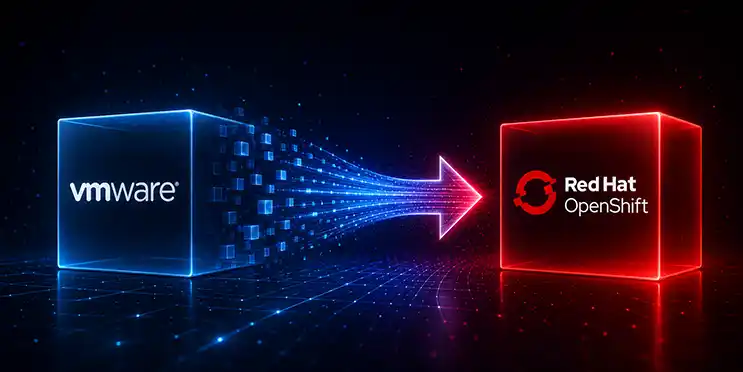
Spearhead AG, an insurance technology provider, took a staged approach when moving from a VMware private cloud to OpenShift. Its development platform and archival data were migrated over a weekend to validate the process, and its production environment followed in a single evening, minimizing disruption to its live services.
What happens after the migration?
Once your workloads are running in the private cloud, ongoing management keeps the platform performing as intended. That includes monitoring performance, managing and optimizing resources, and keeping security consistent, so the environment keeps pace with your needs as they change. It is also worth reviewing workload placement periodically, since the right home for a workload can change as your needs do.
How can a provider support your migration?
Working with a reputable hosting provider to plan your strategy and oversee the migration is key to a successful move. Whether your provider manages the whole process or guides your team, expert engineers help ensure your configuration is optimized and that data integrity and security are maintained.
With our managed private cloud, our engineers work with you from the initial consultation and platform design, through a staged migration that prioritizes your live sites and applications, to ongoing management.
The next steps
Migrating to private cloud goes best when it is planned around your applications, dependencies and risk appetite, and carried out in stages that keep your services running. Whether you are moving from on-premise infrastructure, another provider, public cloud or another virtualization platform, the same principles apply.
If you are planning a migration, speaking with an experienced managed hosting provider can help. Speak to one of our Cloud Consultants about your requirements, or explore our Cloud Migration Content Hub for more information.